
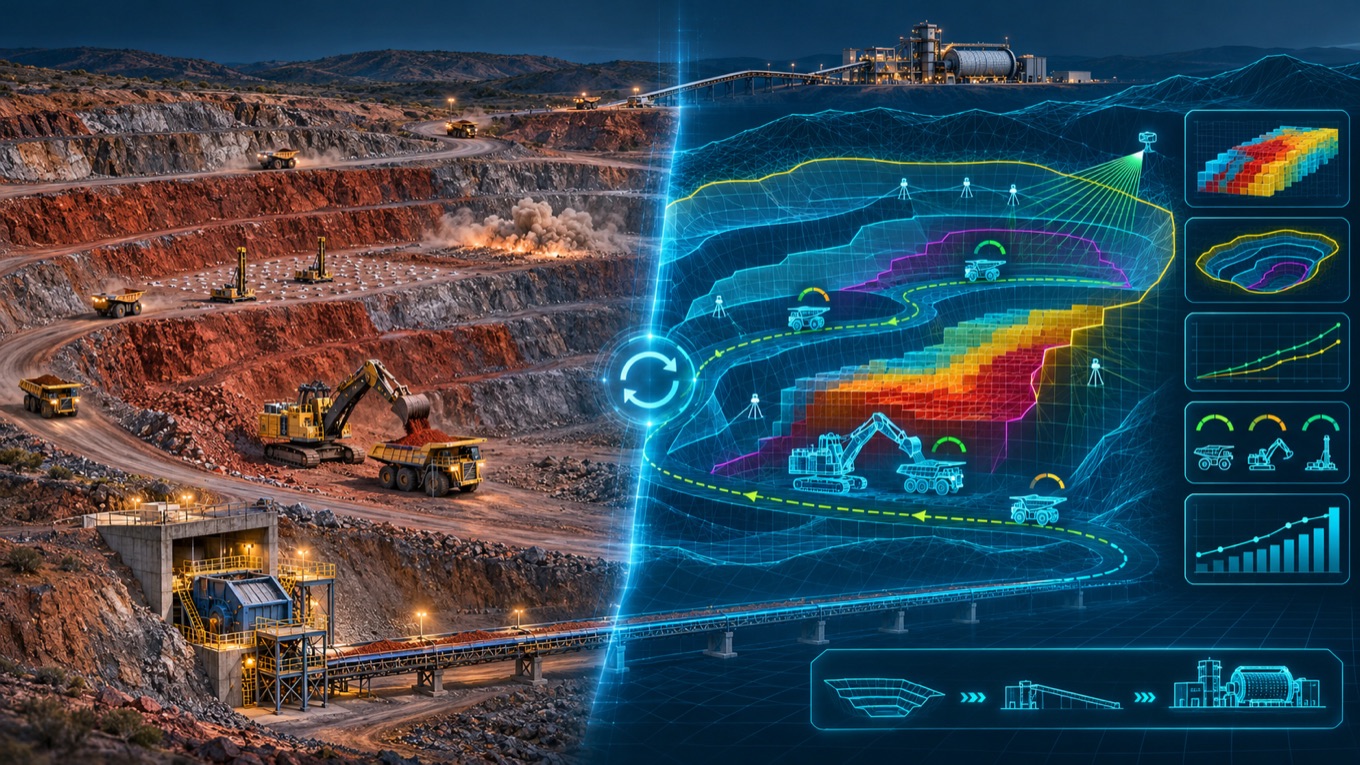
Exploration twin
Connect drillholes, samples, assays, and block-model versions. A planner can trace a grade estimate to the model version and see where additional observations would improve confidence.
Extraction and ground monitoring
Connect benches, fleet cycles and ore destinations with the location and timestamps of ground-based observations. Radar or survey prisms are representative inputs. Qualified site personnel interpret movement within the mine’s ground-control procedure.
Factory-style processing twin
Follow run-of-mine inventory into crushing and applicable separation, dewatering, and loadout. Pair the material record with controller signals, downtime, lab results, throughput and recovery. Use the resulting view to investigate reconciliation gaps.
Systems and modules
Exploration
Connect field observations and laboratory evidence to a versioned geological model.
Extraction
Bring the mine plan, ground observations, fleet, and material movement into the shift workflow.
Mineral processing plant
Model the plant as a factory with equipment, process streams, quality measurements, and production records.
Shared data and reconciliation
Preserve material identity and data provenance across the mine’s three operating domains.
See the next decision take shape.

Critical process pump · Drive-end bearing
A rotating asset shared by steel, mineral-processing, and energy operations.
- Observe the change
- Forecast the trend
- Compare an action
Compare an action
Inspect bearing condition, lubrication, and alignment; connect the finding to a maintenance task.
See the maintenance window before the limit.
A rising vibration trend becomes an inspection window. Replay its development, then compare continued operation with a planned bearing service.
The forecast uses only the evidence available at the selected point.
Inspect the data and forecast
Observed history
| Recorded hour | Bearing vibration · RMS (mm/s) |
|---|---|
| 0 | 1.45 |
| 8 | 1.48 |
| 16 | 1.5 |
| 24 | 1.56 |
| 32 | 1.67 |
| 40 | 1.8 |
| 48 | 2.02 |
| 56 | 2.28 |
| 64 | 2.59 |
| 72 | 2.91 |
Forecast from the selected observation
| Hours ahead | Forecast | With intervention |
|---|---|---|
| 0 | 2.88 | 2.88 |
| 12 | 3.3 | 3.3 |
| 24 | 3.72 | 1.79 |
| 36 | 4.13 | 1.58 |
| 48 | 4.55 | 1.55 |
How this forecast works
The forecast fits a straight-line trend to the last five available observations. Its envelope widens with recent variability and the distance into the future. The comparison applies a stated recovery response after an intervention; it is a scenario, not a diagnosed failure time.
- Review limit
- 4.5 mm/s
- Intervention after
- 12 h
- Recovery target
- 1.55 mm/s

Dracoverse · DRI shaft furnace
A furnace view connecting material flow, the gas circuit, and product evidence.
- Observe the change
- Forecast the trend
- Compare an action
Compare an action
Review the feed, reducing-gas conditions, and laboratory timing with the process team.
Follow quality drift into the next operating hours.
Connect product observations to the decision ahead. Compare continuation of the recent trend with an assumed feed-and-gas stabilization response.
The forecast uses only the evidence available at the selected point.
Inspect the data and forecast
Observed history
| Recorded hour | Product metallization (%) |
|---|---|
| 0 | 94.3 |
| 1 | 94.24 |
| 2 | 94.31 |
| 3 | 94.17 |
| 4 | 94.2 |
| 5 | 94.04 |
| 6 | 93.81 |
| 7 | 93.53 |
| 8 | 93.22 |
| 9 | 92.94 |
Forecast from the selected observation
| Hours ahead | Forecast | With intervention |
|---|---|---|
| 0 | 92.95 | 92.95 |
| 1.5 | 92.53 | 93.08 |
| 3 | 92.11 | 93.76 |
| 4.5 | 91.69 | 94.03 |
| 6 | 91.28 | 94.13 |
How this forecast works
The forecast fits a straight-line trend to the last five available observations. Its envelope widens with recent variability and the distance into the future. The comparison applies a stated recovery response after an intervention; it is a scenario, not a diagnosed failure time.
- Review limit
- 92 %
- Intervention after
- 1 h
- Recovery target
- 94.2 %
Interactive demonstration using an illustrative dataset. Review limits and intervention responses are scenario settings.
Blue Waymark · Industrial engineering
Scope the first useful step
Choose one process boundary, identify its data owners, and agree how the pilot will be evaluated.